
How it works
Machine learning reads the documents. Fixed rules find the gaps.
That one design decision is why a data phleet result holds up in an audit and a chatbot's answer doesn't. Here's what happens between the records you upload and the evidence package you hand the auditor.
01 / Inputs
Whatever your plant already produces.
No templates, no re-keying. The platform takes the records your plants, engineers and HR team already keep, in the formats they're already in:
- Relay settings files and setting sheets (27, 59, 81, 24, 21, 51 and the rest)
- One-line and three-line diagrams, network topology drawings
- Nameplates and manufacturer documentation
- Maintenance records and CMMS exports
- COMTRADE (IEEE C37.111) disturbance records, SER logs and met-station data
- HR, training and access-control exports for CIP-004
02 / Reading
Read, with confidence scores.
Document models extract the values each requirement's evidence depends on: pickups and time delays, CT ratios and rating factors, nameplate MVA, test dates, recorder channels and sample rates. Every extracted value keeps a pointer to where it came from, down to file and page.
When the reading isn't certain, the platform says so. An unknown CT rating factor is flagged as missing data for a human to supply. It's never filled with a typical value, because a plausible assumption is exactly how a compliance record goes wrong without anyone noticing.
03 / Surfacing gaps
One requirement, one set of rules.
Each requirement is written out as deterministic rules: what evidence must exist, the intervals and clocks, the thresholds and exclusions in the standard. The same records produce the same result on every run, and every flag shows the record behind it: missing, overdue, inconsistent or outside a limit.
The rules are written with NERC subject matter experts, including former Regional Entity compliance staff and protection engineers with 25+ years on high-voltage systems, and tested against worked cases before release. When NERC revises a standard (PRC-024-3 to PRC-024-4, CIP-003-9 to -10), the logic is versioned so you can show which version a past result used.
04 / Review
Your team decides. Engineers stay in the loop.
Nothing becomes a compliance record until someone on your team reviews it. Compliance staff close gaps by supplying the missing record or accepting a finding with a reason. Anything that needs engineering judgement, such as a settings question or a coordination margin, goes to your engineers. The reviewer, the decision and the timestamp are kept with the result. The platform does the gathering, organizing and paperwork; accountability stays with your people.
05 / Outputs
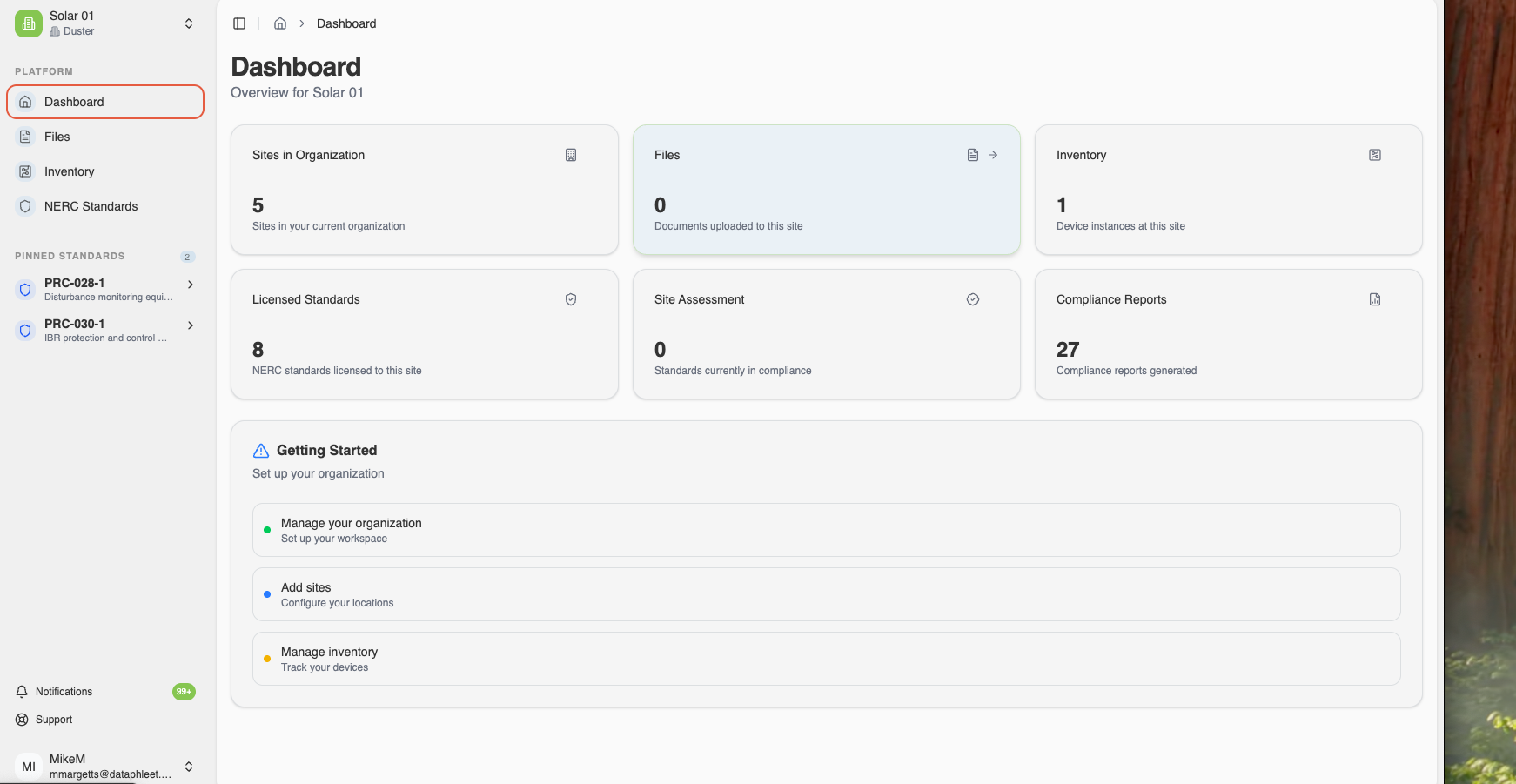
What you hand the auditor.
06 / Running continuously
Evidence that stays current.
data phleet re-runs on demand, on a schedule, or when a new file lands, such as a revised settings file, a new maintenance record, a COMTRADE file or an updated roster. That turns compliance from a scramble before each audit into a state you can look at any day: is our evidence complete right now? For your internal controls, it's the difference between a control that is documented and one you can show is working.
At our RE+ 2026 booth, pressing a button on a real SEL-710 relay trips a simulated 100 MW solar plant. The disturbance recorder writes a COMTRADE file, and data phleet flags the event under PRC-030-1 and starts its clocks with no one touching a keyboard.
See it on your own records.
Thirty minutes with one site's records: we surface the evidence live and show you the gaps. No slides.