
PRC-028-1 IBRAutomated today
Disturbance Monitoring and Reporting Requirements for Inverter-Based Resources
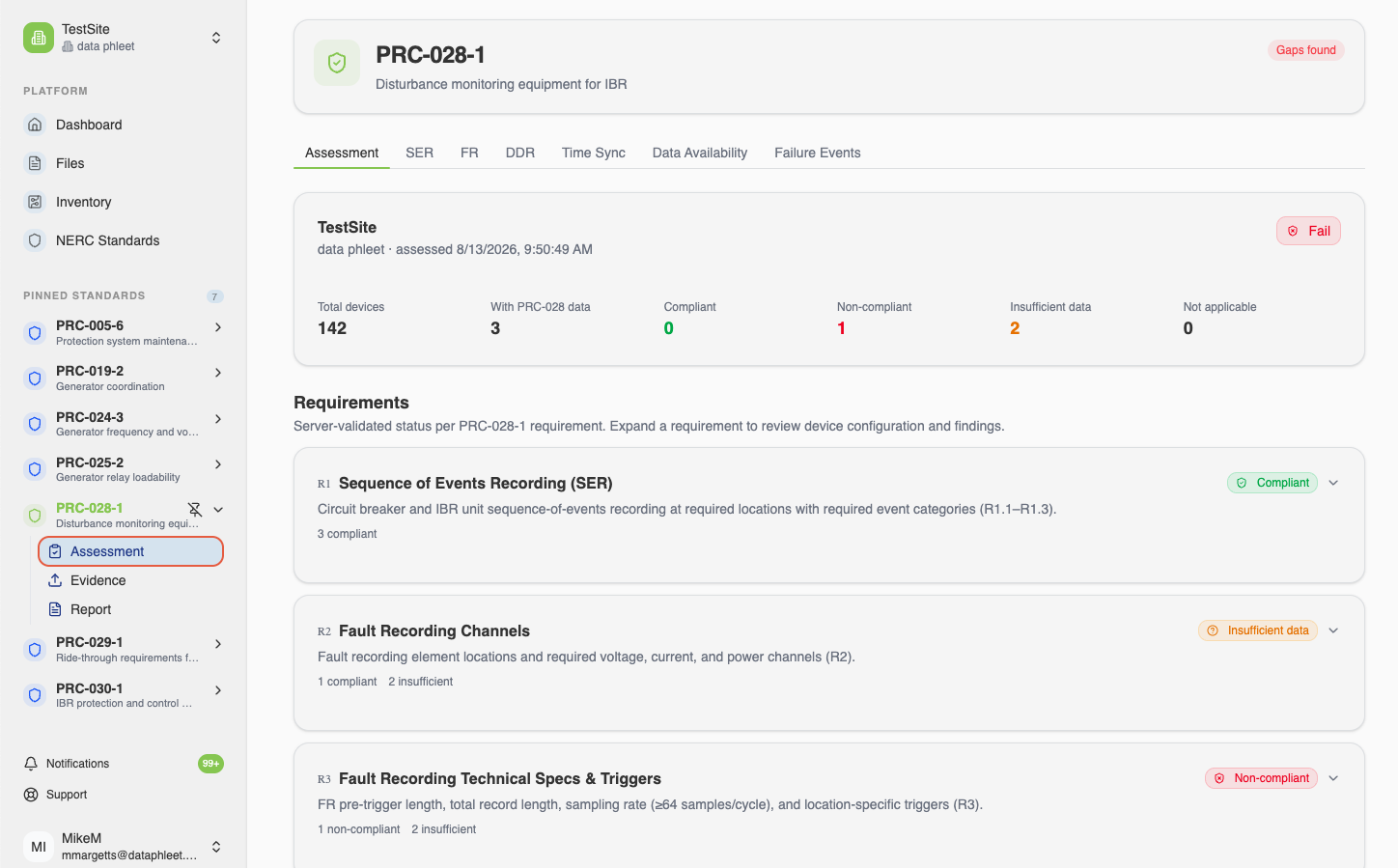
PRC-028-1 requires Generator Owners of inverter-based resources to record what their plants do during disturbances. That means sequence-of-events data (R1), triggered fault recording at the main power transformer and elsewhere (R2–R3), continuous dynamic disturbance recording at ≥ 960 samples/s input and ≥ 60 records/s output (R4–R5), UTC time sync (R6), data retrievable for 20 days and delivered within 15 days of a request (R7), and recording failures fixed or put on a CAP within 90 days (R8).
| Status | In effect, phased implementation |
|---|---|
| Applies to | Generator Owners of BES IBRs and qualifying non-BES IBRs |
| Data types | SER, fault recording (FR), dynamic disturbance recording (DDR) |
| Time sync (R6) | UTC; IBR unit clocks within ±100 ms, all other devices within ±1 ms |
| Retrievability (R7) | 20 calendar days, provided within 15 days of a request; FR as CSV or IEEE C37.111 COMTRADE |
| Failures (R8) | Restore within 90 calendar days, or submit a CAP to the Regional Entity within 90 days |
| Related | PRC-030-1, PRC-029-1 |
What PRC-028-1 requires
Our plain-language summary of each requirement. The standard's text governs.
Sequence of events recording
SER data for breaker position at the main power transformer, collector buses, reactive devices and converters.
Fault recording
Triggered FR data for voltages, currents and power at the MPT high side and other required elements, with at least two cycles pre-trigger and at least 2.0 seconds total record length.
Dynamic disturbance recording
Continuous DDR at each MPT, with input sampling of at least 960 samples per second and output recording at least 60 times per second.
Time synchronization
All SER, FR and DDR synchronized to UTC (local offset allowed). IBR unit clocks within ±100 ms; all other devices within ±1 ms.
Provide data on request
Retrievable for 20 calendar days and delivered within 15 days of a request to the TP, PC, TOP, BA, RC, Regional Entity or NERC, in the specified formats.
Recording failures
When recording capability fails, restore it within 90 calendar days or submit a CAP to the Regional Entity within 90 days and implement it.
Evidence an auditor will ask for
- Actual recordings or derivations, or device specifications and configurations (a single representative design standard may be used)
- Time-sync configuration and accuracy evidence per device class
- Records of data requests and delivery dates
- Failure discovery dates, restoration dates or CAPs
Where teams get caught
- Inverter clocks drifting outside ±100 ms because nobody checks them
- Fault records shorter than 2.0 s or missing pre-trigger cycles
- DDR configured below 960 samples/s input
- Discovering a dead recorder only when someone asks for data, which starts the R8 clock late and the R7 clock badly
What data phleet does for PRC-028-1
- Shows which required elements have SER, FR and DDR coverage on file, across the fleet
- Pulls recorder configuration (record length, pre-trigger, sample rates, channels) out of the files and flags gaps
- Flags time synchronization outside the ±1 ms and ±100 ms limits
- Flags recording failures early and tracks restoration or CAP deadlines
- Feeds the recordings straight into PRC-030-1 event screening
PRC-028-1 questions
What time accuracy does PRC-028-1 require?
All SER, FR and DDR data must be synchronized to UTC. IBR unit clocks must be within ±100 milliseconds of UTC; all other devices within ±1 millisecond.
How long must PRC-028-1 data be kept available?
Retrievable for 20 calendar days, inclusive of the day it was recorded, and provided within 15 calendar days of a request unless the requestor grants an extension.
What file format does fault recording data need?
CSV with appropriate headers, or files conforming to IEEE C37.111 (COMTRADE). SER data goes in ASCII CSV per Attachment 1.
Other standards we cover
- PRC-005-6 Protection System Maintenance
- PRC-019-2 Voltage Regulating Controls Coordination
- PRC-024-4 Frequency and Voltage Protection Settings
- PRC-025-2 Generator Relay Loadability
- PRC-029-1 IBR Ride-through
- PRC-030-1 Unexpected IBR Event Mitigation
- FAC-008-5 Facility Ratings
- CIP-002-5.1a BES Cyber System Categorization
- CIP-003-9 Security Management Controls
- CIP-004-7 Personnel and Training
- Inventory Asset Inventory
See your PRC-028-1 evidence, organized.
Book 30 minutes. Bring one site's records and we'll surface the evidence live, show you the gaps and walk through the reports.