
PRC-030-1 IBRAutomated today
Unexpected Inverter-Based Resource Event Mitigation
PRC-030-1 requires Generator Owners of inverter-based resources to catch, analyze and fix unexpected drops in plant output. Any complete loss of output, or any change of at least 20 MW and at least 10% of gross nameplate within 4 seconds, must be identified (R1), analyzed within 90 calendar days (R2), and, if a performance issue is found, addressed with a Corrective Action Plan or technical justification within 60 days (R3) that is then implemented and tracked (R4).
| Status | Effective October 1, 2026 (phased in) |
|---|---|
| Applies to | Generator Owners of BES IBRs, and of non-BES IBRs that have or contribute to ≥ 20 MVA aggregate nameplate connected at ≥ 60 kV (the Category 2 population) |
| U.S. effective date | October 1, 2026, phased in per NERC's implementation plan, with later dates for some non-BES IBRs |
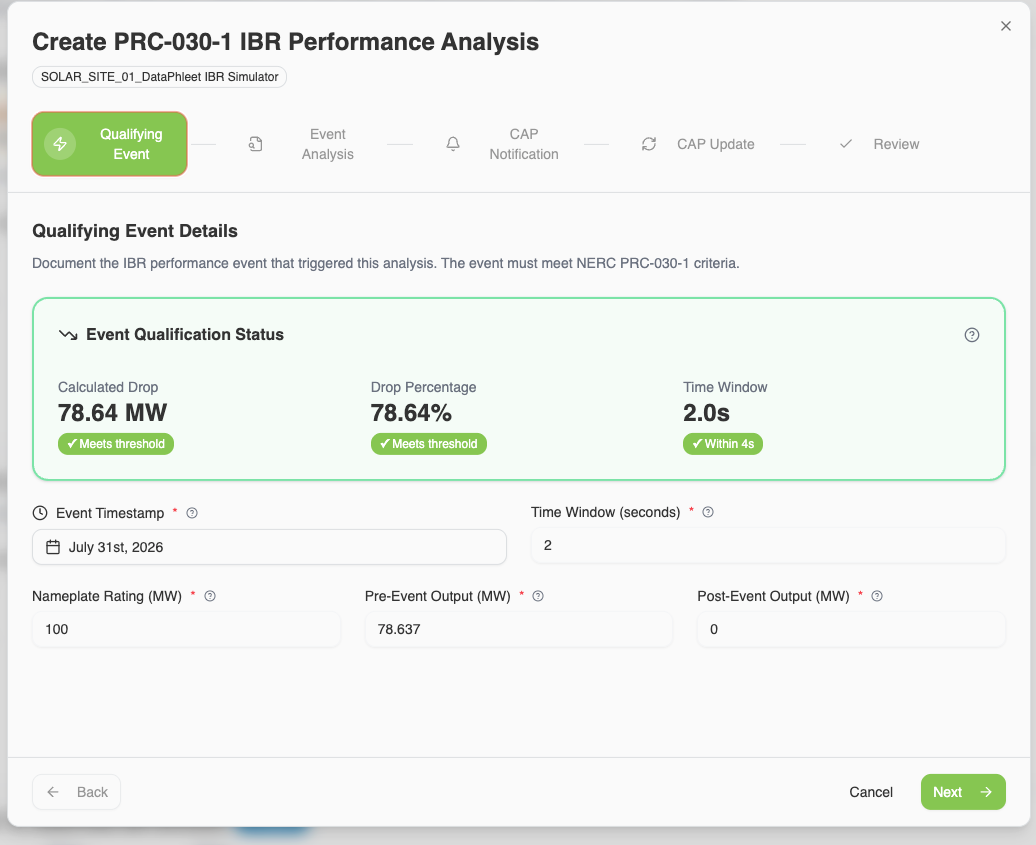
| Trigger (R1) | Complete facility loss of output, or ΔP ≥ 20 MW and ≥ 10% of gross nameplate within 4 s. What counts as an event → |
| Analysis clock (R2) | 90 calendar days from the event or from an RC/BA/TOP request |
| CAP clock (R3) | 60 calendar days after the R2 analysis is complete |
| Evidence retention | 36 calendar months after completing each requirement or CAP |
| Related | PRC-028-1 (the recordings), PRC-029-1 (the ride-through criteria), PRC-004 (misoperations) |
What PRC-030-1 requires
Our plain-language summary of each requirement. The standard's text governs.
Identify qualifying events
Implement a documented process that finds any complete loss of output, or real power changes of at least 20 MW and at least 10% of the plant's gross nameplate within a 4-second period. Four kinds of change are excluded: variation in the energy source (wind speed, irradiance); dispatch, ramping, planned outages and testing; a transmission or collector loss that disconnects the IBR by configuration; and reductions caused solely by a Protection System Misoperation being handled under PRC-004.
Analyze within 90 days
For each qualifying event, or when the RC, BA or TOP asks: determine root cause, document ride-through performance including reactive power response, decide whether corrective action is needed, and determine whether the root cause applies to your other IBR facilities. Provide the analysis to the requesting entity on request.
Corrective Action Plan or justification
If R2 found a performance issue needing correction, within 60 calendar days develop a CAP (covering any of your other affected facilities) or a technical justification for not acting, and send it to the RC, BA and TOP.
Implement and track the CAP
Implement it, update it if actions or timetables change, and notify the RC of changes and of completion.
Evidence an auditor will ask for
- Your documented event-detection process, and proof it actually runs (M1)
- The actual data recordings for each event and the plant's gross nameplate rating (M1)
- A dated analysis report with root cause, ride-through and reactive performance, and the fleet applicability review (M2)
- Dated CAPs or technical justifications, and proof they were transmitted to the RC, BA and TOP (M3)
- Work orders, settings sheets, OEM correspondence and RC notifications showing CAP progress (M4)
Where teams get caught
- Treating every irradiance-driven drop as excluded without evidence. The exclusion is for energy-source variation, so you need met data that shows it.
- No proof the R1 process runs. A procedure on paper doesn't show events were actually screened.
- Missing the 90-day R2 clock because nobody saw the event until a quarterly review. The Lower VSL starts on day 91.
- Analyzing the event but skipping 2.1.4, whether the same root cause applies to your other plants.
What data phleet does for PRC-030-1
- Screens every COMTRADE disturbance record the plant produces against the R1 criteria, using gross nameplate from your asset record
- Tests the four exclusions explicitly. An irradiance exclusion is backed by the met-station data in the same record, not assumed.
- Classifies each event as needs mitigation or excluded, with the reason, and starts the R2 and R3 clocks
- Assembles the record your engineers need for the R2 analysis: drop magnitude and percentage, time window, analog cause (UV, OV, UF, OF) and the source files
- Tracks CAPs, technical justifications and RC/BA/TOP transmittals to completion
- Plant output
- 0.0 MW
- Frequency
- 60.00 Hz
- Voltage
- 0.75 pu
- Irradiance
- 820 W/m²
- Disturbance
- Protection
- COMTRADE
- data phleet
- Record
- SOLAR_SITE_01_UV_20261110_204826.cfg
- Output
- 74.9 MW → 0.0 MW
- Change ≥ 20 MW74.9 MW ✓
- Change ≥ 10% of nameplate74.9% ✓
- Within 4 s0.2 s ✓
- Excluded: irradiance changeno, GHI flat
- Analog causeUV (27) trip
A replay of our RE+ 2026 booth demo: a simulated 100 MW solar plant behind a real SEL-710 relay and SEL RTAC. Press a scenario to trip the plant (or pass a storm over it) and watch the R1 screening classify the COMTRADE record. Timing is sped up; the protection delay in the simulator is 30 s.
PRC-030-1 questions
Does PRC-030-1 apply to Category 2 IBRs?
Yes. Applicability includes non-BES IBRs that have or contribute to an aggregate nameplate capacity of 20 MVA or more, connected at 60 kV or above, which is the Category 2 population NERC registered in 2026. Check NERC's implementation plan for the phase-in dates that apply to non-BES facilities.
Is a drop caused by a passing cloud a PRC-030-1 event?
No. Changes associated with intermittent energy-source availability, such as variation in solar irradiance or wind speed, are excluded under R1. You should still be able to show why, which is why data phleet ties the exclusion to the irradiance recorded with the event.
What's the difference between PRC-030-1 and PRC-028-1?
PRC-028-1 requires the recording equipment and data (SER, fault recording, DDR). PRC-030-1 requires you to use that data to find, analyze and fix unexpected output changes. Without PRC-028 data, PRC-030 analysis is guesswork.
How long do we have to analyze an event?
90 calendar days from the event, or from a request by your RC, BA or TOP. If corrective action is needed, the CAP or technical justification is due 60 days after that analysis.
Other standards we cover
- PRC-005-6 Protection System Maintenance
- PRC-019-2 Voltage Regulating Controls Coordination
- PRC-024-4 Frequency and Voltage Protection Settings
- PRC-025-2 Generator Relay Loadability
- PRC-028-1 IBR Disturbance Monitoring
- PRC-029-1 IBR Ride-through
- FAC-008-5 Facility Ratings
- CIP-002-5.1a BES Cyber System Categorization
- CIP-003-9 Security Management Controls
- CIP-004-7 Personnel and Training
- Inventory Asset Inventory
See your PRC-030-1 evidence, organized.
Book 30 minutes. Bring one site's records and we'll surface the evidence live, show you the gaps and walk through the reports.